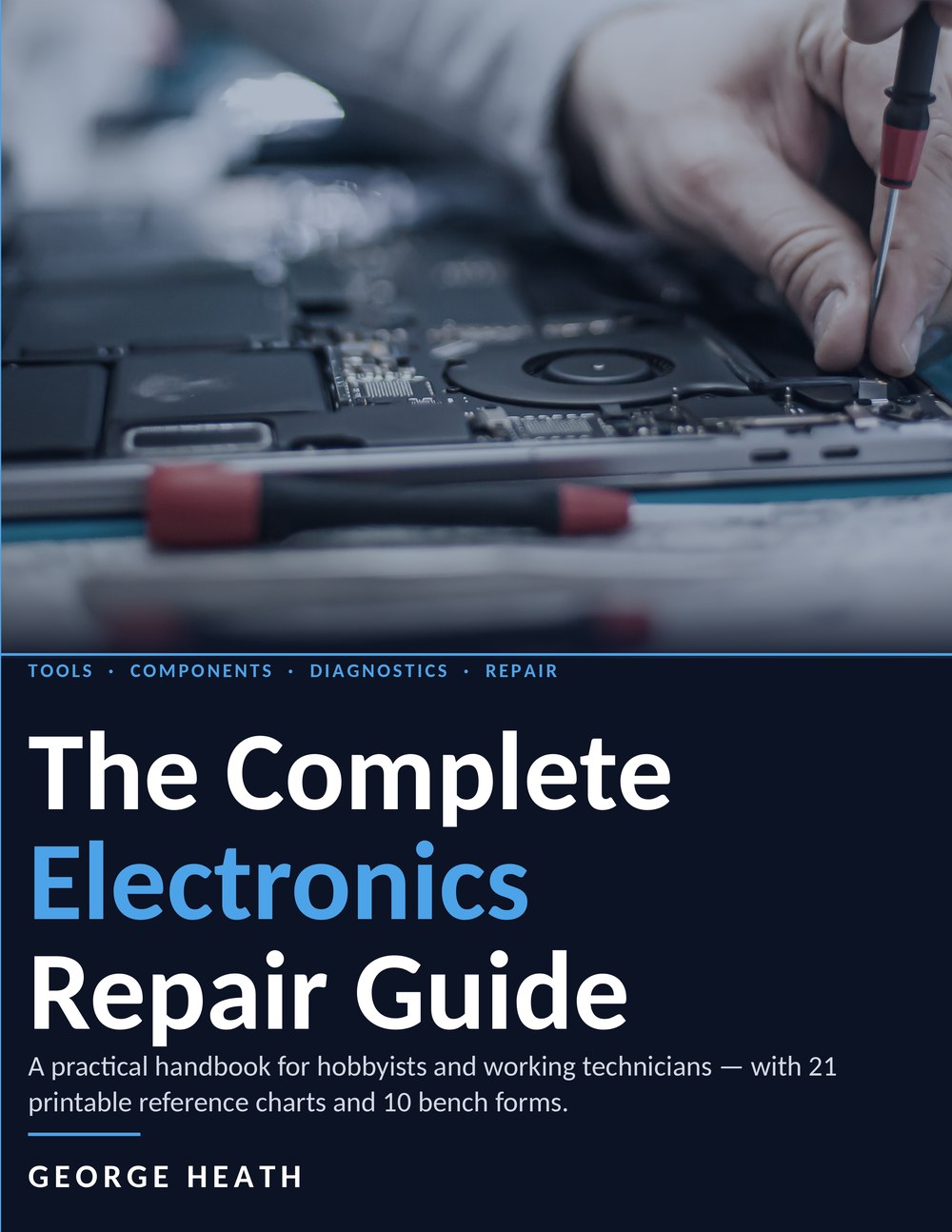
Tools · Components · Diagnostics · Repair
A five-cent capacitor. A cracked solder joint. A blown fuse, a corroded connector, a dried-out thermal pad. Every day, working devices are thrown away for faults that take under an hour to fix — if you know how.
This book teaches you how. It assumes no knowledge beyond high-school science and builds toward confident, component-level repair. Not guesswork. Not parts-swapping. A method.
Paperback · 262 pages · 8.5 × 11 in · full color
What's inside
Thirty chapters in eight parts. You can read it front to back, or open it at the component in your hand and find out what your meter should be telling you.
Safety, your workspace and tools, and the small amount of electrical theory you actually need. Mains voltage, capacitor discharge, meter CAT ratings, ESD, lithium cells. Read this part first, in order.
A working reference. What each part does, how it fails, and exactly how to test it. Dip in and out.
Hands-on technique: measurement, oscilloscopes, soldering, rework, disassembly and cleaning.
How to actually find a fault. The diagnostic flow, then short hunting, intermittent faults and thermal problems — the three that waste the most time.
What typically breaks in each category of device, and where to look first.
Advanced work, part sourcing, counterfeit parts, and running repair as a business: intake, pricing, warranty, liability, and what you owe a customer whose device is full of their life.
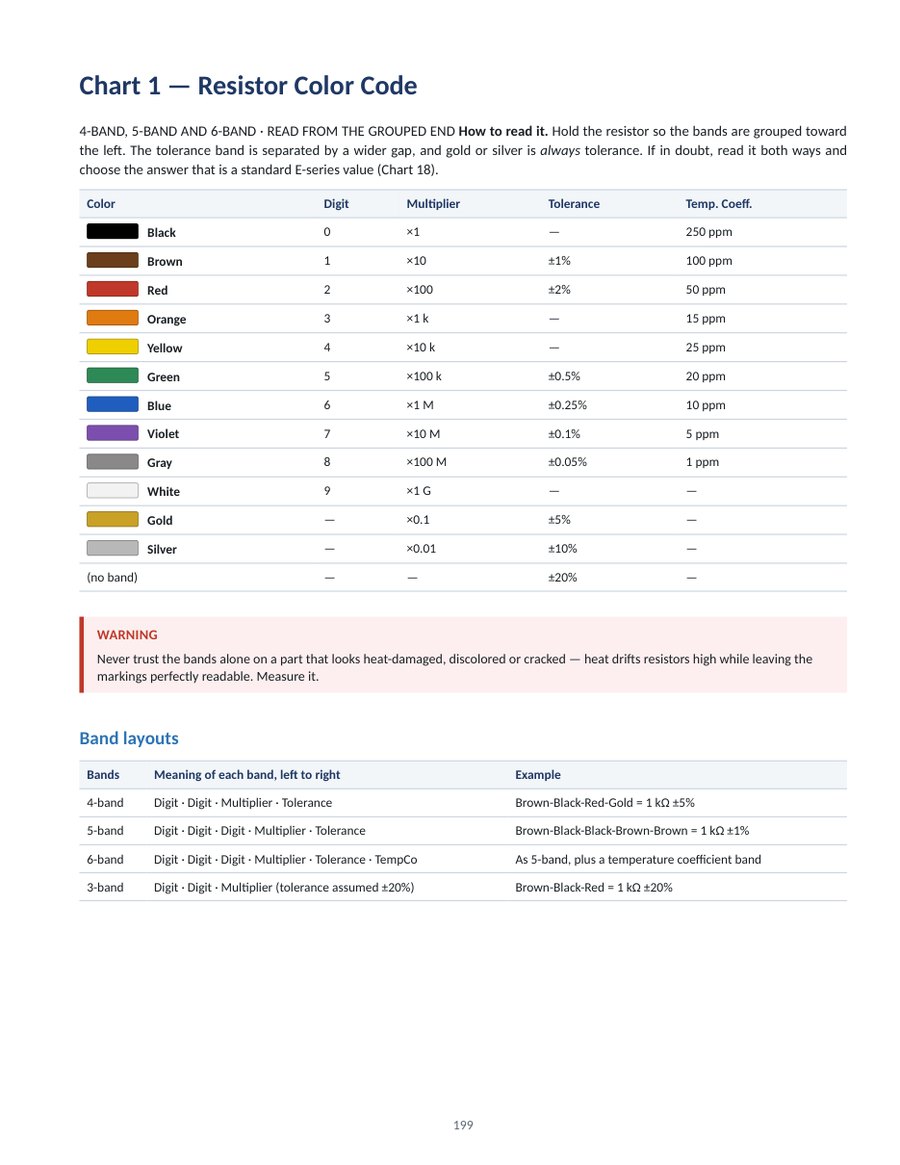
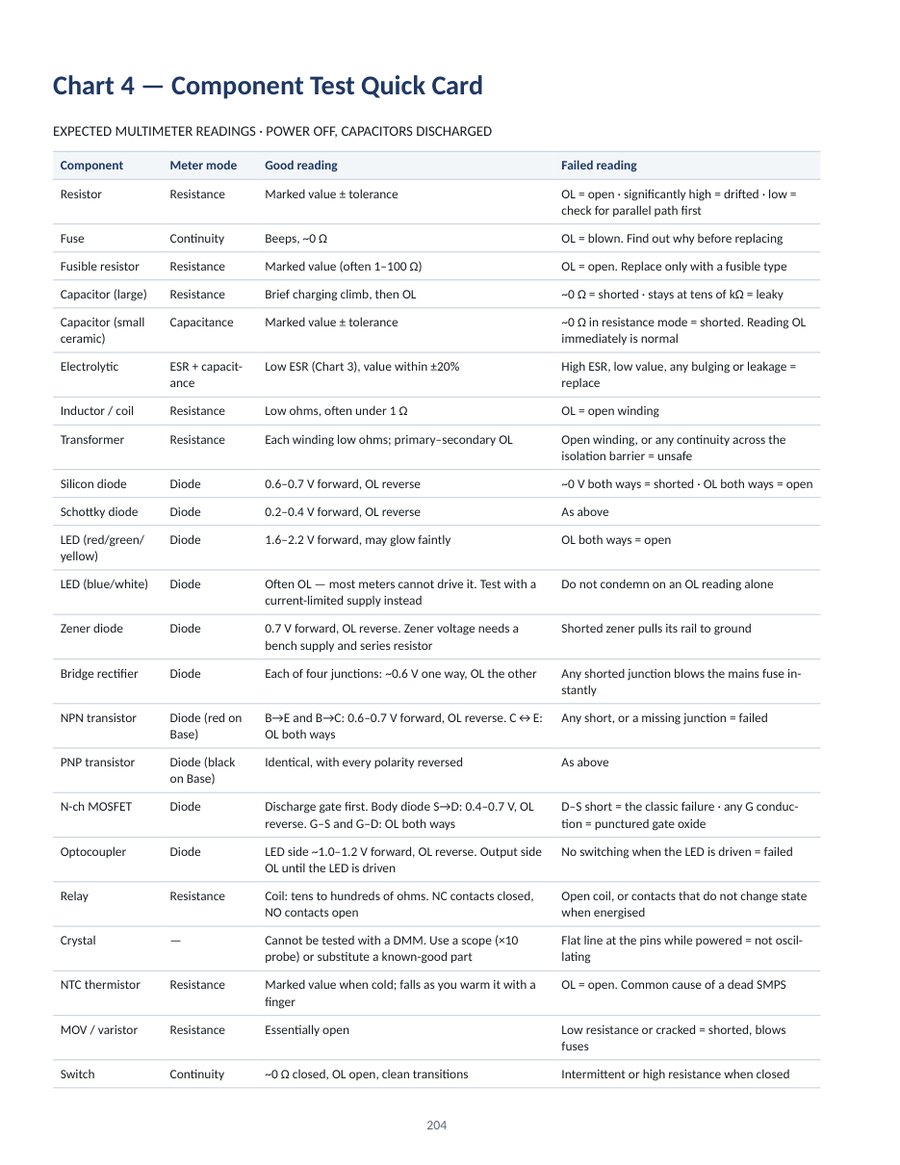
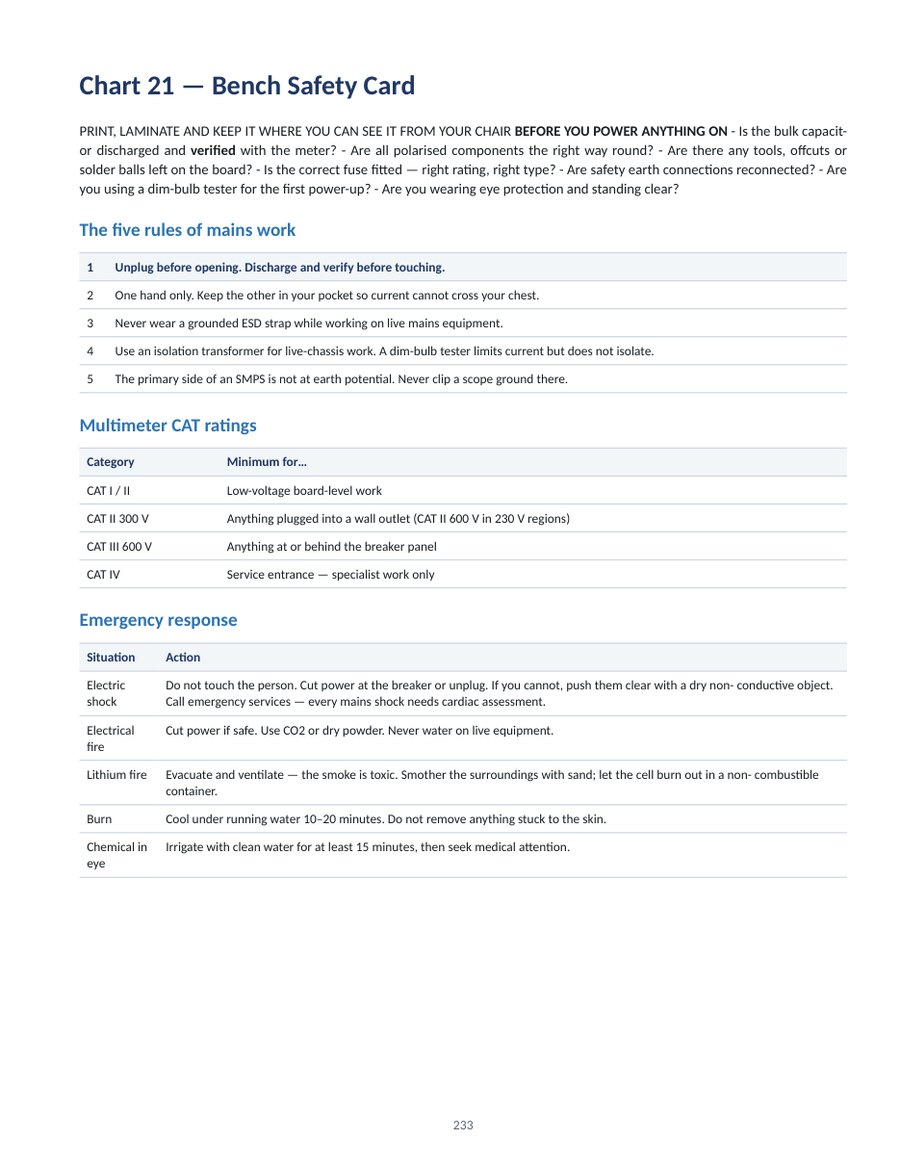
21 printable charts: color codes, package sizes, pinouts and test values. Pin them to the wall. Two print at actual size, with a calibration ruler to prove your printer hasn't scaled them.
10 printable forms: intake sheets, repair log, voltage maps, checklists and tags. Print a fresh set for every job.
Look inside
Large format, so diagrams and tables are usable at working size. Two charts print at actual size, with a calibration ruler so you can prove your printer hasn't scaled them.
Get the book
262 pages, full color, 8.5 × 11. Lies flat on a bench, survives flux and fingerprints, and the reference charts are already printed for you.
Buy on AmazonThe same 262 pages, delivered instantly. 442 bookmarks so you can jump to any chapter or chart, and every form and chart prints as many times as you need — a fresh intake sheet for every job.
Buy the PDF
The author
A US Navy veteran who has spent years at the bench doing exactly what this book describes: finding out why something stopped working, and putting it right. SolderBee Academy exists to pass that on — plainly, without mystique, and without pretending that repair is harder than it is.
Questions about the book, or a repair you're stuck on? Get in touch, or follow along for repair videos.